A wonderful article about our work in Science to Sage
|
We Are Not Alone
The Discovery of Dolphin Language
For immediate release—November 2011
Key words: Dolphin, Cetacean, Echolocation, Cymatics, Holography, Language,
CymaScope.
Researchers in the United States and Great Britain have made a significant
breakthrough in deciphering dolphin language in which a series of eight
objects have been sonically identified by dolphins. Team leader, Jack
Kassewitz of SpeakDolphin.com, ‘spoke’ to dolphins with the dolphin’s own
sound picture words. Dolphins in two separate research centers understood
the words, presenting convincing evidence that dolphins employ a
universal “sono-pictorial” language of communication.
The team was able to teach the dolphins simple and complex sentences
involving nouns and verbs, revealing that dolphins comprehend elements
of human language, as well as having a complex visual language of their
own. Kassewitz commented, “We are beginning to understand the visual
aspects of their language, for example in the identification of eight dolphin
visual sounds for nouns, recorded by hydrophone as the dolphins
echolocated on a range of submersed plastic objects.”
The British member of the research team, John Stuart Reid, used a
CymaScope instrument, a device that makes sound visible, to gain a better
understanding of how dolphins see with sound. He imaged a series of the
test objects as sono-pictorially created by one of the research dolphins.
In his bid to “speak dolphin” Jack Kassewitz of SpeakDolphin.com, based in Miami,
Florida, designed an experiment in which he recorded dolphin echolocation
sounds as they reflected off a range of eight submersed objects, including a plastic
cube, a toy duck and a flowerpot. He discovered that the reflected sounds
actually contain sound pictures and when replayed to the dolphin in the form of a
game, the dolphin was able to identify the objects with 86% accuracy, providing
evidence that dolphins understand echolocation sounds as pictures. Kassewitz
then drove to a different facility and replayed the sound pictures to a dolphin that
had not previously experienced them. The second dolphin identified the objects
with a similar high success rate, confirming that dolphins possess a sono-pictorial
form of communication. It has been suspected by some researchers that dolphins
employ a sono-visual sense to ‘photograph’ (in sound) a predator approaching
their family pod, in order to beam the picture to other members of their pod,
alerting them of danger. In this scenario it is assumed that the picture of the
predator will be perceived in the mind’s eye of the other dolphins.
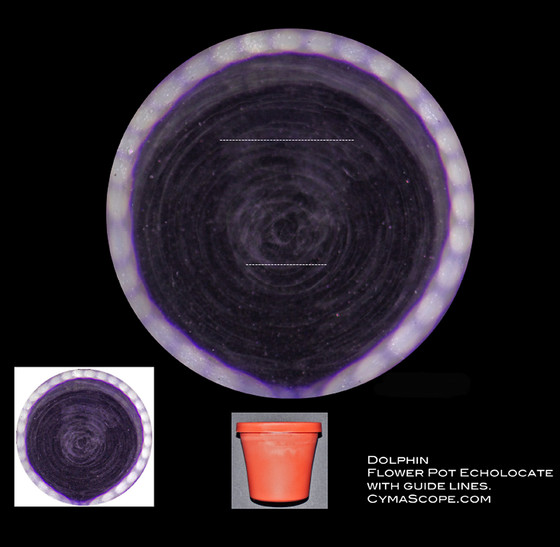
When Reid imaged the reflected echolocation sounds on the CymaScope it
became possible for the first time to see the sono-pictorial images that the dolphin
created. The resulting pictures resemble typical ultrasound images seen in hospitals.
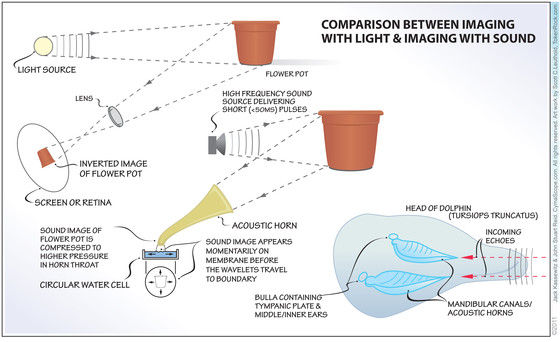
Reid explained: “When a dolphin scans an object with its high frequency sound
beam, emitted in the form of short clicks, each click captures a still image, similar to
a camera taking photographs. Each dolphin click is a pulse of pure sound that
becomes modulated by the shape of the object. In other words, the pulse of
reflected sound contains a semi-holographic representation of the object. A
portion of the reflected sound is collected by the dolphin’s lower jaw, its mandible,
where it travels through twin fat-filled ‘acoustic horns’ to the dolphin’s inner ears to
create the sono-pictorial image.”
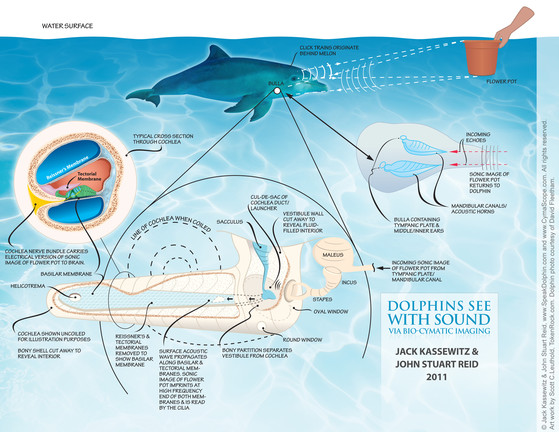
The precise mechanism concerning how the sonic image is ‘read’ by the
cochleae is still unknown but the team’s present hypothesis is that each click-pulse
causes the image to momentarily manifest on the basilar and tectorial
membranes, thin sheets of tissue situated in the heart of each cochlea.
Microscopic cilia connect with the tectorial membrane and ‘read’ the shape of
the imprint, creating a composite electrical signal representing the object’s shape.
This electrical signal travels to the brain via the cochlea nerve and is interpreted as an image. (The example in the graphic shows a flowerpot.) The team postulates
that dolphins are able to perceive stereoscopically with their sound imaging sense.
Since the dolphin emits long trains of click-pulses it is believed that it has persistence
of sono-pictorial perception, analogous to video playback in which a series of still
frames are viewed as moving images.
Reid said, “The CymaScope imaging technique substitutes a circular water
membrane for the dolphin's tectorial, gel-like membrane and a camera for the
dolphin's brain. We image the sono-picture as it imprints on the surface tension of
water, a technique we call ‘bio-cymatic imaging,’ capturing the picture before it
expands to the boundary. We think that something similar happens in the dolphin’s
cochleae where the sonic image, contained in the reflected click-pulse, travels as
a surface acoustic wave along the basilar and tectorial membranes and imprints in
an area that relates to the carrier frequency of the click-pulse. With our bio-
cymatic imaging technique we believe we see a similar image to that which the
dolphin sees when it scans an object with sound. In the flowerpot image the hand
of the person holding it can even be seen. The images are rather fuzzy at present
but we hope to enhance the technique in future.”
Dr Horace Dobbs is Director of International Dolphin Watch and a leading authority
on dolphin-assisted therapy. “I find the dolphin mechanism for sonic imaging
proposed by Jack Kassewitz and John Stuart Reid plausible from a scientific
standpoint. I have long maintained that dolphins have a sono-visual language so I
am naturally gratified that this latest research has produced a rational explanation
and experimental data to verify my conjectures. As early as 1994, in a book I wrote
for children, Dilo and the Call of the Deep, I referred to Dilo's ‘Magic Sound’ as the
method by which Dilo and his mother pass information between each other using
sonic imaging, not just of external visual appearances, but also of internal structures
and organs.”
As a result of Reid’s bio-cymatic imaging technique Kassewitz, in collaboration with
research intern Christopher Brown, of the University of Central Florida, is beginning
to develop a new model of dolphin language that they are calling Sono-Pictorial
Exo-holographic Language, (SPEL). Kassewitz explained, “The ‘exo-holographic’ part of the acronym derives from the fact that the dolphin pictorial language is
actually propagated all around the dolphin whenever one or more dolphins in the
pod send or receive sono-pictures. John Stuart Reid has found that any small part
of the dolphin’s reflected echolocation beam contains all the data needed to
recreate the image cymatically in the laboratory or, he postulates, in the dolphin’s
brain. Our new model of dolphin language is one in which dolphins can not only
send and receive pictures of objects around them but can create entirely new
sono-pictures simply by imagining what they want to communicate. It is perhaps
challenging for us as humans to step outside our symbolic thought processes to
truly appreciate the dolphin’s world in which, we believe, pictorial rather than
symbolic thoughts are king. Our personal biases, beliefs, ideologies, and memories
penetrate and encompass all of our communication, including our description and
understanding of something devoid of symbols, such as SPEL. Dolphins appear to
have leap-frogged human symbolic language and instead have evolved a form of
communication outside the human evolutionary path. In a sense we now have a
‘Rosetta Stone’ that will allow us to tap into their world in a way we could not have
even conceived just a year ago. The old adage, ‘a picture speaks a thousand
words’ suddenly takes on a whole new meaning.”
David M. Cole, founder of the The AquaThought Foundation, a research
organization that stud ied human-dolphin interaction for more than a decade said,
“Kassewitz and Reid have contributed a novel model for dolphins' sonic
perception, which almost certainly evolved out of the creature's need to perceive
its underwater world when vision was inhibited. Several conventional linguistic
approaches to understanding dolphin communication have dead-ended in the
last 20 years so it is refreshing to see this new and highly-nuanced paradigm being
explored.”
The human capacity for language involves the acquisition and use of a complex
system of vocal sounds to which we attribute specific meanings. Language, the
relationship between sounds and meanings evolved differently for each tribe of
humans and for each nation. It is generally believed that the human language
faculty is fundamentally different from that of other species and of a much higher
complexity. The development of vocal language is believed to have coincided
with an increase in brain volume. Many researchers have wondered why dolphins have brains comparable in size with those of humans, considering that Nature
creates organs according to need. The Kassewitz team’s findings suggest the large
dolphin brain is necessary for the acquisition and utilization of a sono-pictorial
language that requires significant brain mass.
Dolphins enjoy constant auditory and visual stimulation throughout their lives, a fact
that may contribute to their hemispheric brain coordination. The dolphin’s auditory
neocortical fields extend far into the midbrain, influencing the motor areas in such
a way as to allow the smooth regulation of sound-induced motor activity as well as
sophisticated phonation needed for production of signature whistles and sono-
pictures. These advantages are powered not only by a brain that is comparable in
size to that of a human but also by a brain stem transmission time that is
considerably faster than the human brain.
Kassewitz said, “Our research has provided an answer to an age-old question
highlighted by Dr Jill Tarter of the SETI Institute, ‘Are we alone?’ We can now
unequivocally answer, ‘no.’ SETI’s search for non-human intelligence in outer space
has been found right here on earth in the graceful form of dolphins.”
Full results of this research are available on request from Jack
Kassewitz.
Jack Kassewitz: speakdolphin@mac.com 305-807-5812 - Miami, Florida
John Stuart Reid: john@sonic-age.com
|
All photographs, sounds and video on this site are Copyrighted and Protected under U.S. and International Law.
|
|
Jack's work has been features in numerous publications and on many TV shows
|
|
|